Why Transform, Build, and Learn Belong Together
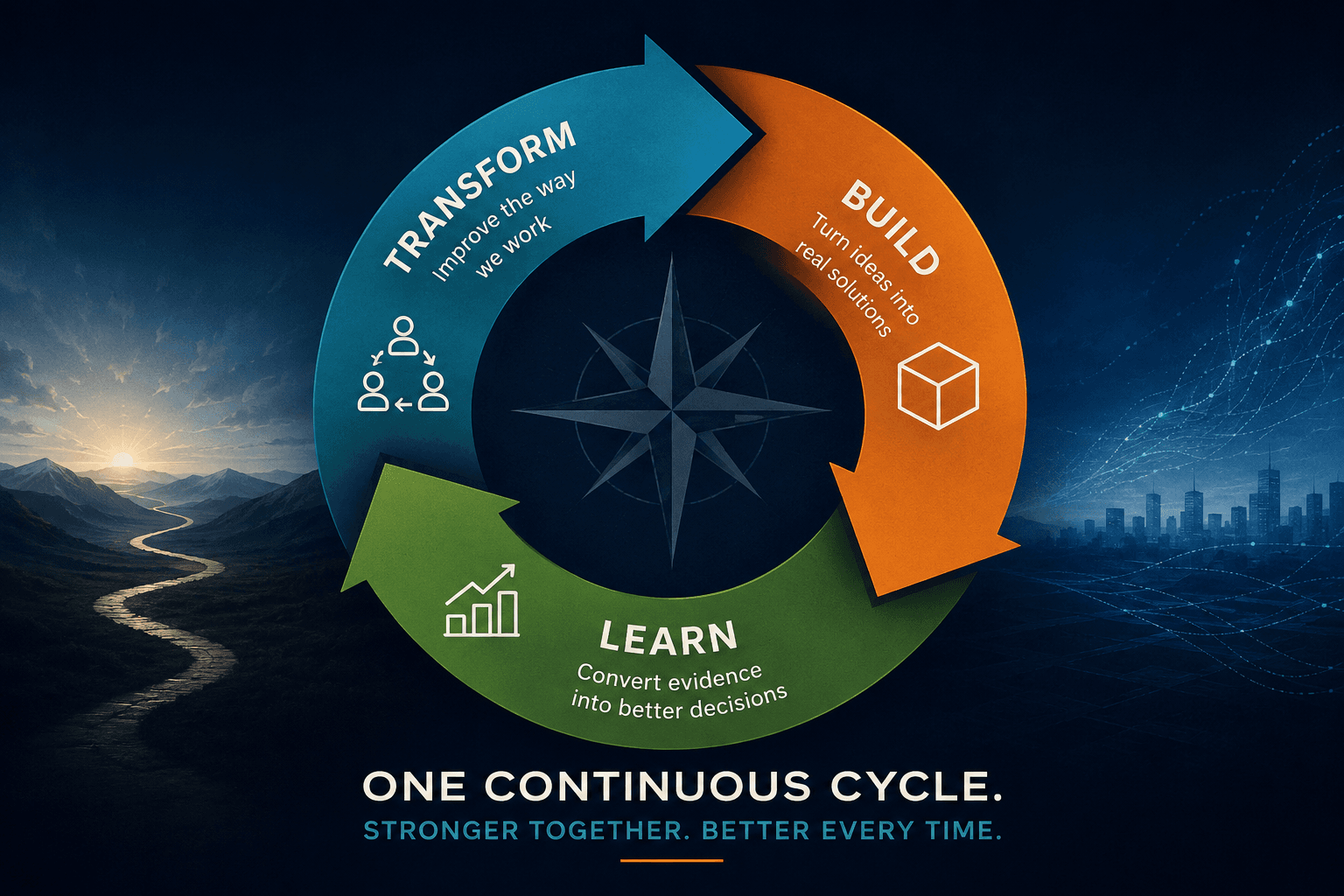
When I chose Transform. Build. Learn. as the tagline for Vector North Advisory, I wasn’t trying to come up with three catchy words that looked good on a website. Nor was I trying to create three separate service offerings. In my mind, those three words describe a continuous operating cycle. Each one reinforces the next, and separating them is one of the biggest reasons product organizations struggle to realize the full value of any one of them.
Most organizations don’t intentionally separate transformation, product development, and learning. It simply happens over time.
Transformation becomes the responsibility of executives, consultants, or a special initiative with a name and a steering committee. Product teams continue building software much as they always have, occasionally checking in on the progress of the transformation effort but rarely feeling like they’re an integral part of it. Learning, meanwhile, gets pushed into retrospectives, post-launch reviews, customer satisfaction surveys, or annual planning sessions. Everyone agrees that learning is important, yet it often becomes something that happens after the work rather than something that shapes the work as it unfolds.
On the surface, this seems perfectly reasonable. Each activity has different stakeholders, different objectives, and different measures of success. Unfortunately, this separation creates a subtle but important problem. Each discipline begins optimizing for itself rather than strengthening the others.
I’ve seen transformation programs produce beautifully documented operating models that never meaningfully changed how products were built. I’ve watched talented product teams deliver innovative software while continuing to work inside decision-making structures that slowed them down at every turn. I’ve also seen organizations gather tremendous amounts of customer feedback and operational data, only to move on to the next roadmap without fundamentally changing how they approached the next problem.
None of those efforts failed because the people involved lacked talent or commitment. They failed because the connection between transforming, building, and learning had been broken.
Transformation, by itself, doesn’t create value. It creates the conditions under which value can be created.
That may seem like an obvious statement, but it’s one that organizations frequently overlook. Changing reporting structures, introducing new processes, adopting AI tools, or reorganizing teams can all be worthwhile investments. However, those changes only prove their value when they improve the organization’s ability to build better products and make better decisions. Until those ideas are tested through real work, they remain educated assumptions.
The reverse is equally true.
Building products without changing how the organization works often leads to local optimization. Teams find ways to work around broken processes, compensate for unclear decision-making, and navigate organizational friction because they’re motivated to deliver. Good people can overcome remarkable obstacles for surprisingly long periods of time. The danger is that the organization mistakes their resilience for an effective operating model.
Eventually, those workarounds become institutionalized. Success depends less on repeatable systems and more on individual heroics. New employees struggle to understand why things are done a certain way because many of the answers amount to, “That’s just how we’ve always handled it.”
Learning suffers in much the same way.
Most organizations collect far more information than they convert into knowledge. Customer interviews are conducted. Analytics dashboards are reviewed. AI generates summaries. Teams hold retrospectives and discuss lessons learned. Yet months later, many of the same debates reappear because very little of that information actually changes how future decisions are made.
Collecting information is not the same as learning. Learning only occurs when new evidence changes the way an organization thinks, decides, or behaves.
If a customer interview causes a team to rethink the problem they’re solving, that’s learning. If a prototype disproves an assumption and the organization changes direction because of it, that’s learning. If an implementation reveals weaknesses in an operating model and leadership responds by changing how teams work together, that’s learning.
Without those changes, information remains just that: information.
This distinction becomes even more important in the age of AI.
Much of the conversation surrounding AI focuses on productivity. How much faster can developers write code? How many support tickets can be automated? How much documentation can be generated? These are useful questions, but I don’t believe they’re the most important ones.
The more interesting question is what happens when the cost of learning drops dramatically.
Ideas that once required weeks of engineering effort can now be explored in days. Teams can prototype workflows before making large investments. Customer feedback can be synthesized almost immediately. Product managers can evaluate multiple approaches before committing to one. The cost of exploring possibilities has fallen in ways that would have been difficult to imagine only a few years ago.
That changes the economics of product development.
For decades, organizations optimized around the scarcity of engineering effort because building software was expensive. Today, one of the scarcest resources is no longer the ability to build. It’s the ability to consistently identify the right problems, interpret evidence wisely, and make better decisions than competitors.
In other words, the competitive advantage is shifting from execution alone toward learning.
That’s why I believe transformation, building, and learning can no longer be treated as separate activities.
Transformation creates an environment where better decisions are possible.
Building turns ideas into something tangible that customers and teams can experience.
Learning ensures that every success, every failure, and every surprise improves the organization’s ability to make the next decision.
When those three activities operate as a continuous cycle, they reinforce one another. Transformation improves the quality of the work being built. Building generates evidence that challenges assumptions. Learning strengthens the organization’s judgment, which informs the next transformation. Over time, the organization doesn’t simply produce more software. It becomes better at recognizing opportunities, responding to change, and adapting to new information.
That distinction is important because software itself rarely creates a lasting competitive advantage. Competitors eventually catch up. Features are replicated. Technologies evolve. What is much harder to replicate is an organization that consistently learns faster than everyone else.
That idea sits at the heart of everything we’re building at Vector North Advisory.
Transform. Build. Learn. is not a sequence of consulting services. It is a way of thinking about how modern product organizations create lasting value. Each element exists to strengthen the others, creating a cycle that becomes more valuable every time it turns.
We’ll spend much more time exploring that philosophy in future articles, including the principles behind Adaptive Outcome Delivery™, the operating philosophy that underpins our work. For now, I would encourage you to ask a simple question about your own organization.
When your team finishes building something, what has improved?
Hopefully the product has.
The more important question is whether the organization has improved as well.
Because if every product leaves your organization smarter than it was before, you’re creating something far more valuable than software. You’re building an organization that gets better every time it builds.
.png)