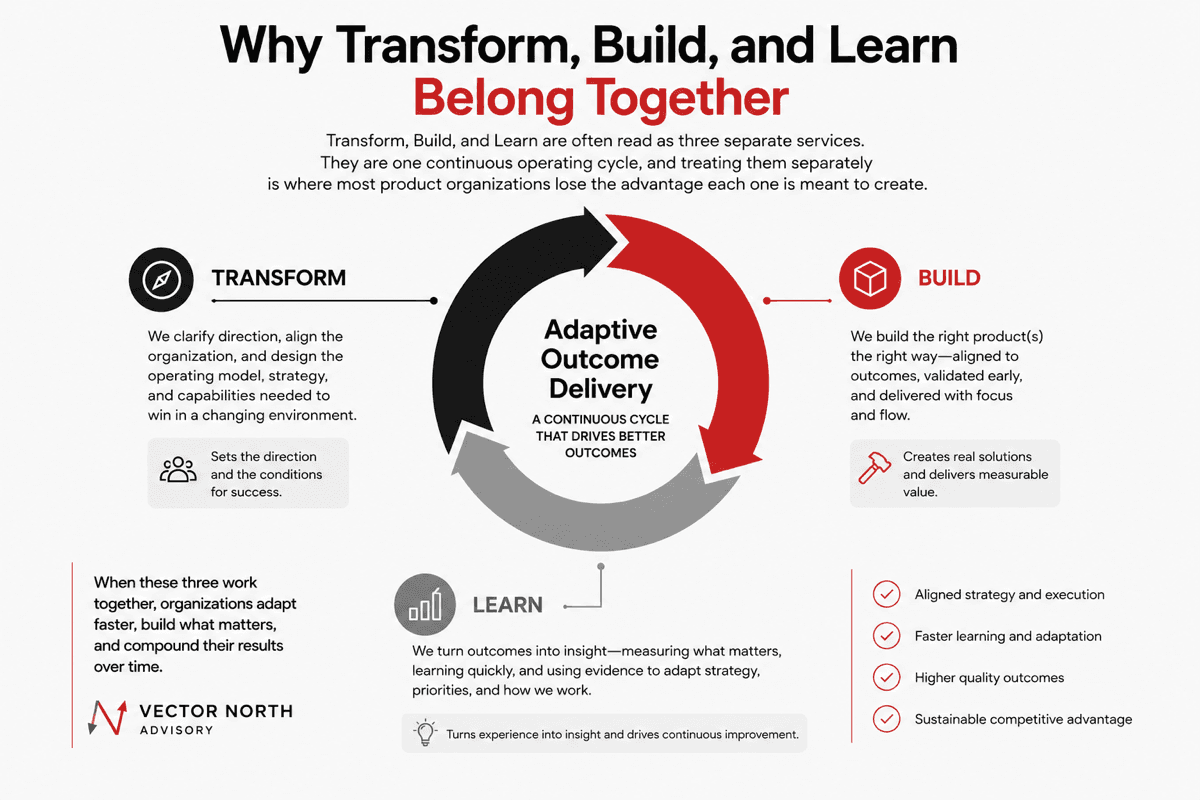
It is easy to read Transform, Build, and Learn as a list of three services, the way most firms present a page of offerings. That reading misses the point. They are three phases of one cycle, and the value of each phase depends on whether the other two are actually connected to it.
Transform changes how the organization works
Transform is not a rebrand of change management, and it is not a project to install a new tool. It is a shift in how an organization identifies opportunities, aligns around outcomes, organizes product work, and uses AI throughout the product lifecycle rather than bolting it on beside the existing process. Most of what makes transformation hard is not the technology. It is that organizations front-load planning because they assume exploration is expensive, then lock in assumptions before anyone has real evidence. AI has changed that economics. What used to take months of engineering to explore can often be tested in weeks, which means the old trade-off, more planning in exchange for fewer expensive mistakes, no longer holds the way it used to.
Build turns that opportunity into evidence
None of that matters if the organization cannot turn a validated opportunity into something real. Build is where an idea becomes an MVP, a prototype, an internal tool, or an AI-native application, sized to answer the specific question in front of the team rather than to impress a steering committee. The goal of building is not the artifact. It is the evidence the artifact produces: does this actually work, do customers actually want it, was the original assumption right.
A build that does not produce evidence is just an expensive guess with better production values. A build that does produce evidence, even evidence that the idea does not hold up, is a successful outcome, because it replaces an assumption with something the organization now knows.
Learn is where that evidence becomes capability
This is the phase most organizations skip, not because they disagree with it, but because nothing forces them to do it. Teams move from one initiative to the next without systematically capturing what worked, what failed, which assumptions turned out to be wrong, or why a decision succeeded. The next project starts from roughly the same blank page as the last one.
Producing output is not the same as generating evidence. Generating evidence is not the same as interpreting it. And interpreting it is not the same as converting it into something the rest of the organization can actually use the next time a similar decision comes up. Learn is the discipline of closing that gap: turning what a team just observed into stronger product judgment, a reusable method, or a documented decision that the next team does not have to rediscover from scratch.
The point is the loop, not the labels
Adaptive Outcome Delivery, the methodology behind how Vector North structures its own engagements, exists because of this connection. Its objective is not to build faster for its own sake. It is to compress the distance between an observed signal, a product hypothesis, a working solution, evidence of value, and organizational learning, without skipping the discipline that makes the evidence trustworthy.
Which means Learn is not a separate line of business that happens to sit next to Transform and Build. It is what makes the next cycle of Transform and Build sharper than the last one. An organization that treats these as three unrelated capabilities will get three unrelated results. An organization that treats them as a loop gets something that compounds.
.png)